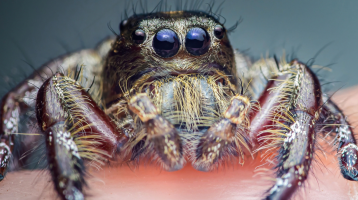
They hunt skillfully, respond to their surroundings, and appear to enter a state at night that bears striking similarities to our sleep. Researchers have observed two distinct sleep phases in an Australian jumping spider—including a phase with rapid eye movements and muscle twitches reminiscent of human REM sleep. Whether the animals actually dream remains an open question. However, the discovery raises a larger question: How far back do the evolutionary roots of sleep extend?
A Tiny Hunter With a Surprising Secret
Spiders are probably not the animals that most people first think of when it comes to sleep or even dreams. They often appear motionless, can react in the blink of an eye, and are known for their complex hunting strategies. But what happens when they actually rest? A research team led by scientists at the University of Bonn has been investigating this question. The focus was on the Australian jumping spider Portia fimbriata. This species is particularly interesting because it hunts other spiders using astonishingly sophisticated strategies. For example, some members of the genus mimic the vibrations of captured prey to lure other spiders.
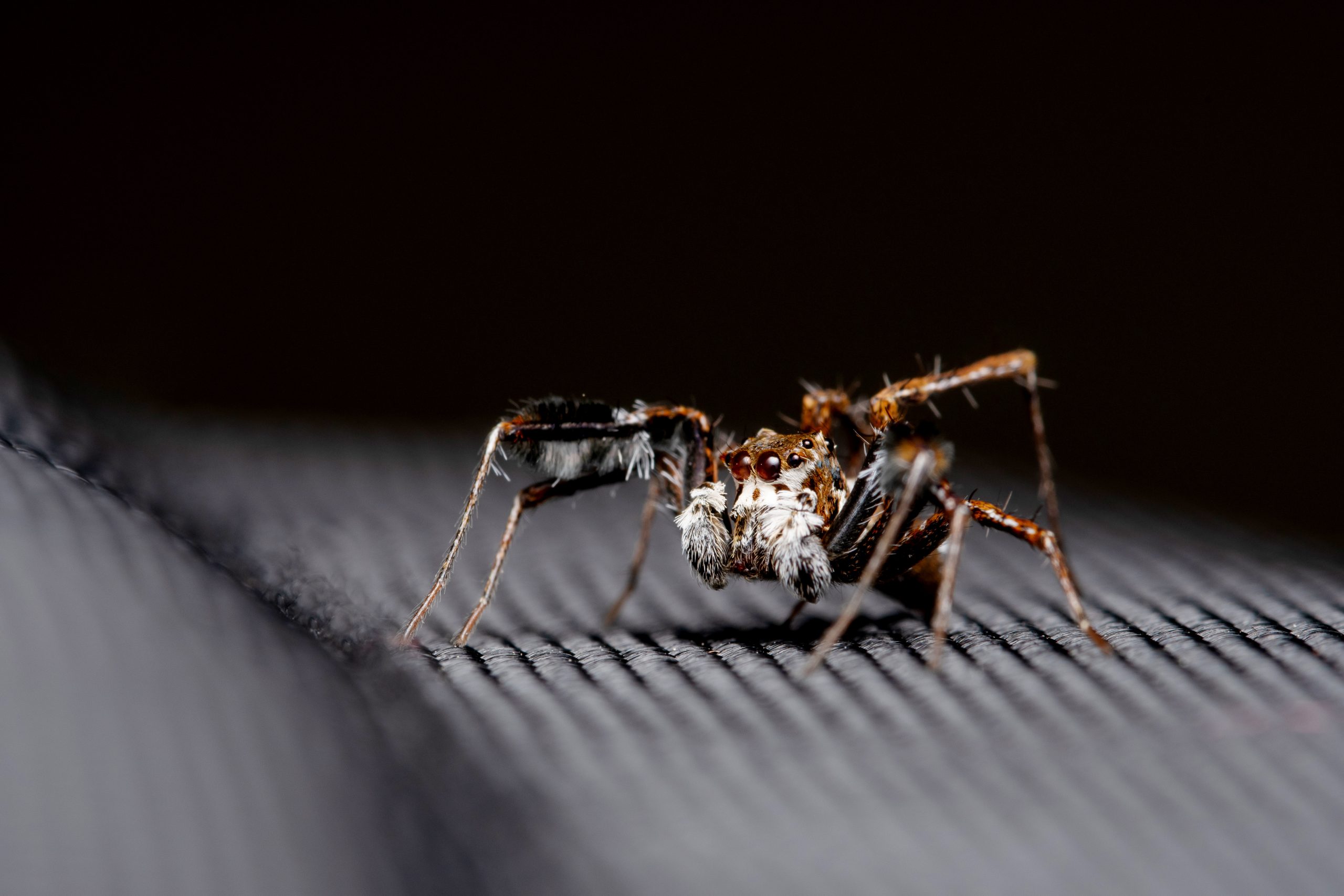 The researchers wanted to find out whether these animals actually sleep or merely take extended rest periods. They also investigated whether different states, comparable to the sleep stages of other animals, can be identified within these periods.
The result was remarkable: The observations suggest a regular sleep pattern with two distinct phases. One of these exhibits behavioral characteristics reminiscent of REM sleep in humans and other vertebrates. The results were published in the journal Proceedings of the National Academy of Sciences.
When Something Suddenly Moves During Sleep
REM sleep is a special sleep phase. The abbreviation stands for “Rapid Eye Movement.” In humans, this phase is characterized, among other things, by distinctive eye movements and intense brain activity. Many particularly vivid dreams are reported to occur during this sleep phase. In the jumping spider, the scientists also observed conspicuous movements during certain resting phases. These included rapid eye movements—or movements of the eye structures—as well as brief muscle twitches.
That alone would not have been sufficient evidence of sleep. After all, animals can exhibit movements even when at rest without actually sleeping. Therefore, the team examined additional behavioral characteristics. The spiders were observed over several days and nights using high-resolution cameras. During the dark phase, infrared cameras were used so that the animals could be recorded with as little disturbance as possible. The researchers documented the spiders’ body postures, periods of rest, and recurring episodes of REM-like movements.
Of particular importance was the question of how the spiders reacted to external stimuli. This is because sleep differs from mere rest, among other things, in that responsiveness is altered. The researchers used acoustic stimuli and examined how quickly the spiders reacted to them. During certain REM-like phases, the animals were less easily awakened. This provided the scientists with further evidence that the behavior was not simply a matter of remaining motionless.
Catching Up on Sleep: Further Evidence
A particularly interesting aspect of the study concerned what is known as “sleep rebound.” This refers to the body’s response to sleep deprivation: if sleep is disrupted or shortened, the body may subsequently attempt to make up for some of the lost sleep. This phenomenon is also observed in humans. After a period of insufficient sleep, the duration or intensity of certain sleep phases may change.
The researchers investigated whether similar changes could be observed in the spiders following a disruption of their nighttime rest. Indeed, the animals subsequently exhibited more REM-like episodes. Together with the altered responses to stimuli and the recurring sleep phases, this finding supports the interpretation that the spiders undergo a regulated sleep state. This is scientifically significant because the study does not rely solely on externally observable movements. Several independent behavioral traits point in the same direction.
Do Spiders Really Dream?
This is where the particularly fascinating part of the story begins—and at the same time, the area where scientific caution is important. In humans, REM sleep is often associated with vivid dreams. This quickly raises the question of whether jumping spiders might also have internal experiences during their REM-like phase. However, the current study cannot answer this question.
The researchers recorded the animals’ behavior but were unable to directly measure their brain activity. Therefore, it cannot be determined whether the observed phases correspond neurologically to human REM sleep. Nor is it known whether the spiders have subjective experiences during this time that can meaningfully be compared to human dreams. The observed movements also do not prove that the animals replay their hunting strategies or other experiences while sleeping.
The precise conclusion is therefore: The spiders exhibit a regular sleep pattern with a REM-like phase. Whether they dream remains an open question. It is precisely this distinction that makes the discovery interesting. It shows that scientists must not only look for external similarities but also examine, step by step, what conclusions the data actually allow.
What Does this Have to Do With Our Sleep?
At first glance, the sleep habits of a small spider and human sleep seem to have little in common. Humans have a complex brain with billions of nerve cells. Spiders have a nervous system with a completely different structure. Nevertheless, the study could help us better understand the fundamental characteristics of sleep.
 Human sleep consists of various stages that alternate multiple times throughout the night. These include different non-REM stages and REM sleep. These phases differ, among other things, in their brain activity, their physical manifestations, and their significance for various biological processes. Distinct sleep states and recurring REM-like episodes were also observed in the jumping spider. This does not mean that its sleep architecture is identical to that of humans. However, it suggests that certain characteristics of multiphase sleep need not be limited to vertebrates.
This raises a fundamental question for evolutionary biology: Have some characteristics of sleep arisen independently multiple times over the course of evolution, or do they partly stem from very ancient biological mechanisms? The new study does not provide a definitive answer. However, it broadens the foundation on which this question can be investigated.
The Spider’s Internal Clock
The study is also interesting from the perspective of chronobiology. This field of science deals with biological rhythms and how organisms organize their activity over time. The researchers observed pronounced diurnal activity and a circadian rhythm in Portia fimbriata. Biological rhythms that last approximately 24 hours are referred to as circadian. In humans, the internal clock controls, among other things, when we become tired, when we are at our most productive, and how various bodily functions change throughout the day.
In many animals, such rhythms are closely linked to the alternation between light and darkness. The internal clock can orient itself to external cues, particularly light. At the same time, under suitable conditions, biological rhythms can continue even without a regular external cycle. The study of jumping spiders provides evidence that activity, rest, and various sleep phases are also organized over time in these animals.
However, this does not imply that their internal clock functions exactly like that of humans. Rather, the study shows that the temporal organization of rest and activity can also be investigated in animals with a differently structured nervous system. This is particularly valuable for chronobiology: anyone who wants to understand biological rhythms should not limit their studies exclusively to species whose physiology is particularly similar to that of humans.
Why the Research Must Continue Now
Despite the remarkable results, numerous questions remain unanswered. A key task is to determine whether comparable sleep phases also occur in other spider species. The researchers therefore intend to compare the sleep patterns of various spiders. In addition, they plan to investigate whether the behavior of animals in their natural environment differs from that under laboratory conditions.
Another area of research is the connection between sleep and cognitive abilities. The sophisticated hunting strategies of the genus Portia raise the question of whether certain sleep phases might be linked to learning or memory processes. Whether this is actually the case and what mechanisms underlie it remains to be investigated.
Environmental influences could also play a role.Artificial light at night disrupts the natural light-dark cycles of many organisms and can disturb biological rhythms. Whether and how such influences affect the sleep of spiders is another open research question.
In the long term, comparative studies could help identify those characteristics of sleep that are common across very different groups of animals. This would be an important step toward understanding which functions of sleep are particularly fundamental and how they have evolved over time.
Conclusion: A Look at the Origins of Sleep
The Australian jumping spider demonstrates that sleep can be more complex than it appears at first glance, even in an animal with a completely different nervous system. The observed sleep phases, reduced responsiveness, and changes following disrupted nighttime rest provide compelling behavioral evidence of a regulated sleep pattern with a REM-like phase. Whether the spiders actually dream remains unclear. It would also be premature to draw a direct parallel with human REM sleep.
However, the discovery opens up an exciting perspective: It may be possible to study fundamental characteristics of sleep not only in mammals and birds, but also in animals whose nervous systems are organized quite differently.
For chronobiology, this means broadening the perspective. Sleep and biological rhythms are not topics that concern humans exclusively. Anyone who wants to understand their fundamentals must also look where one would initially least expect to find them—for example, in a small spider resting under its web at night.
You may also be interested in...
-

A major breakthrough in the understanding of the sleep mechanism opens up new possibilities for…
-
With sleep disorders becoming increasingly common, it is no surprise that a growing number of…