Most people are familiar with the advice to “sleep on it” when faced with difficult decisions. New research suggests that this advice may have scientific merit. While many people report having had breakthrough ideas in their dreams, researchers have had difficulty studying this phenomenon because dreams are difficult to control in a laboratory setting.
A new study by neuroscientists at Northwestern University shows that it is possible to influence people’s dreams. The findings support the idea that REM sleep, the phase of sleep with rapid eye movement in which vivid and sometimes lucid dreams occur, may be particularly helpful for creative problem solving. The study, “Creative problem solving after experimental induction of dreams about unsolved puzzles during REM sleep,” was published on February 5 in the journal Neuroscience of Consciousness.
What Happens in Dreams
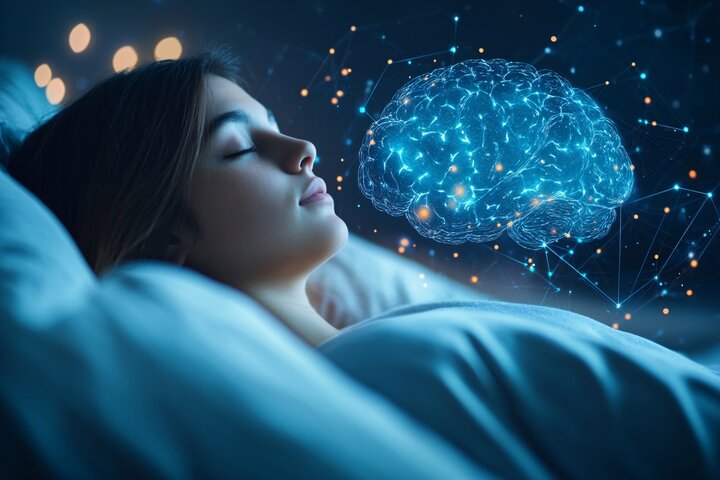
A lot happens in the body and brain during dreams, even though we lie quietly in bed. Dreams are particularly intense during the so-called REM (rapid eye movement) phase of sleep. During this phase, the brain is almost as active as when we are awake. Areas responsible for emotions, such as the amygdala, are particularly active, which is why dreams are often very emotional. At the same time, the prefrontal cortex, which is responsible for logical thinking and control, is less active. This explains why dreams often seem illogical, erratic, or surreal, without this seeming strange to us in the dream.
 Memories are also processed. Experiences from the day, older memories, and current thoughts are linked in new ways and sorted into existing memory structures. This is why familiar people or places often appear in dreams, but in a changed or mixed-up form. Many researchers believe that dreams play an important role in processing emotions and consolidating memory. Some theories also see dreams as a kind of training ground for problem solving or social situations.
The body also reacts: the eyes move rapidly under closed eyelids, breathing and heartbeat can become irregular, and the muscles are almost completely relaxed or even temporarily paralyzed. This muscle inhibition protects us from actually performing movements from the dream. Although dreams often feel very real, they originate entirely in the brain – through the interplay of memory, emotion, imagination, and internal activity during sleep.
Shaping Dreams With Acoustic Signals
The researchers used a technique called “targeted memory reactivation” (TMR). While the participants were asleep, they played them sounds that reminded them of previous attempts to solve certain puzzles. These acoustic signals were only played after brain monitoring confirmed that the participants were asleep. As a result, 75% of participants reported dreams that contained elements or ideas related to the unsolved puzzles. Puzzles that appeared in dreams were solved much more frequently than those that did not. Participants solved 42% of dream-related puzzles, compared to 17% of the others.
Nevertheless, the results do not prove that dreaming directly leads to better solutions. Other factors, such as increased curiosity about certain puzzles, may have influenced both dreaming and performance. Still, successfully controlling dream content is an important step forward in understanding how sleep can support creative thinking.
“Many problems in today’s world require creative solutions. By learning more about how our brains can think creatively, rethink, and develop creative new ideas, we may be able to get closer to solving the problems we want to solve, and sleep engineering may help,” said lead author Ken Paller, James Padilla Professor of Psychology and Director of the Cognitive Neuroscience Program at Northwestern University’s Weinberg College of Arts and Sciences.
Insight Into the REM Sleep Experiment
The study involved 20 participants who already had experience with lucid dreaming, meaning they were sometimes aware that they were dreaming while still asleep. In the lab, each person attempted to solve a series of brain teasers, with three minutes allowed for each task. Each task was accompanied by its own distinctive soundtrack. Most of the tasks remained unsolved due to their level of difficulty.
The participants then spent the night in the laboratory while the researchers recorded their brain activity and other physiological signals using polysomnography. During REM sleep, the scientists played the soundtracks to half of the unsolved puzzles to selectively reactivate these memories. Some participants used pre-agreed signals, such as specific inhalation and exhalation patterns, to indicate that they had heard the sounds and were actively working on the puzzles in their dreams.
The next morning, the participants described their dreams. Many reported images or ideas related to the puzzles. For 12 of the 20 participants, the dreams related more frequently to the puzzles associated with acoustic signals than to puzzles without signals. The same participants were more likely to solve the reactivated puzzles after waking up, improving their success rate from 20% to 40%—which was significant. Karen Konkoly, lead author of the study and postdoctoral fellow in Paller’s Cognitive Neuroscience Laboratory, said one of the biggest surprises was how strongly the cues influenced dreams, even when participants were unclear.
“Even without clarity, one dreamer asked a dream character for help solving the puzzle we gave them. Another received the clue ‘trees’ and woke up while dreaming of running through a forest. Another dreamer received a puzzle about jungles as a cue and woke up from a dream in which she was fishing in the jungle and thinking about this puzzle,“ Konkoly said. ”These were fascinating examples because they showed how dreamers can follow instructions and that dreams can be influenced by sounds during sleep, even without clarity.”
What This Means for Creativity and Mental Health
 The connection to creativity is particularly exciting. REM sleep has long been considered a phase of intense brain activity in which emotional centers work hard while logical control mechanisms are muted. This creates unusual connections between memories, knowledge, and current issues. When people think through a specific problem before falling asleep or are given a creative task, dreams more often take up this topic. The study showed that participants developed more original and flexible solutions after such “guided” dreams than control groups.
The reason for this is probably the special way the brain works during REM sleep: it combines stored information more freely and less strictly logically than when awake. This can give rise to new, surprising ideas – a process that is crucial for creative problem solving. Historically, there are many reports of artists and scientists drawing inspiration from dreams; current neuroscientific findings now provide experimental evidence that this effect could be systematically exploited.
The team plans to use targeted methods of memory reactivation and interactive dreams to explore other possible functions of dreaming, including emotion regulation and broader learning processes. “I hope these findings will help us reach more informed conclusions about the functions of dreaming,” Konkoly said. “If scientists can definitively say that dreams are important for problem solving, creativity, and emotion regulation, hopefully people will begin to take dreams seriously as a priority for mental health and well-being.” In the long term, such findings could have practical applications—for example, in promoting creative processes, in learning, or even in therapy, for example, to positively influence stressful content in nightmares. However, researchers emphasize that targeted dream control is still in its infancy and that ethical issues—such as conscious intervention in inner worlds of experience—must be carefully discussed.
You may also be interested in...
-

Have your dreams been more vivid and bizarre during the last few months? If so,…
-
Scientists at UC Merced have developed artificial cells that can measure time perfectly – similar…
-
Looking for the best study strategy for effective recall? Studying before bedtime may be the…