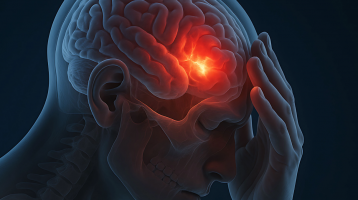
Deep sleep does far more than simply allow the body to rest – it activates a powerful, brain-controlled system that regulates growth hormone, thereby promoting muscle and bone strength, metabolism and even mental performance. Scientists have now decoded the neural circuits behind this process, uncovering a delicate feedback loop in which sleep stimulates the release of growth hormone, and this same hormone in turn helps to regulate wakefulness.
What Happens During Deep Sleep
Deep sleep is the most intense phase of sleep and is part of what is known as non-REM sleep. During this phase, brain activity slows down significantly, as evidenced by slow, steady delta waves. The body is in a state of maximum recovery: heart rate, breathing and blood pressure drop, the muscles relax completely, and external stimuli barely penetrate the consciousness. This is precisely why it is so difficult to wake someone from deep sleep. Deep sleep does more than just make you feel rested. It actively regenerates the body, strengthens the muscles, promotes bone growth and aids fat burning. For adolescents, it is also crucial for reaching their full growth potential.
 During this phase, key regenerative processes take place in the background. Of particular importance is the increased release of growth hormone, which plays a key role in tissue repair, muscle building and bone stabilisation. At the same time, the immune system is activated, damaged cells are renewed and inflammatory processes are regulated. Energy metabolism is also affected: the body draws more heavily on fat reserves, which contributes to weight regulation in the long term. Deep sleep occurs mainly in the first half of the night and is closely linked to the natural sleep rhythm. If this rhythm is disrupted – for example, by irregular sleeping times, stress or artificial light – it is often precisely this important phase that is shortened. This has a direct impact on physical recovery: despite getting enough sleep, you don’t really feel rested, performance levels drop, and long-term processes such as muscle building or growth can also be impaired.
It is also interesting to note that deep sleep supports not only the body but also, indirectly, the brain. Whilst the processing of memories takes place more extensively during other sleep phases, without sufficient deep sleep the stable foundation for this is lacking. One can imagine it as a system that first needs to be ‘maintained’ before it can function optimally. Overall, deep sleep is therefore far more than just ‘deep sleep’: it is a highly active, biologically crucial phase in which the body systematically regenerates, repairs itself and prepares for the next day. Scientists have long puzzled over why poor sleep – particularly the early deep sleep phase – leads to lower levels of the important growth hormone.
Scientists Discover the Underlying Brain Circuitry
Researchers at the University of California, Berkeley, have now found the answer. In a study published in the journal ‘Cell’, they have mapped the brain circuits that control the release of growth hormones during sleep and identified a new feedback system that keeps these levels in balance. This discovery provides a clearer understanding of how sleep and hormones interact. It could also pave the way for new treatments for sleep disorders linked to metabolic conditions such as diabetes, as well as neurological diseases such as Parkinson’s and Alzheimer’s.
“We know that growth hormone release is closely linked to sleep, but until now this has only been observed through blood samples and by monitoring growth hormone levels during sleep,” said the study’s lead author, Xinlu Ding, a postdoctoral researcher in the Department of Neuroscience and at the Helen Wills Neuroscience Institute at UC Berkeley. “We are actually recording neural activity directly in mice to see what is going on. We’re providing a fundamental circuit that can be built upon in the future to develop various treatment methods.” Lack of sleep doesn’t just make you tired. As growth hormones help regulate the body’s processing of sugar and fat, poor sleep can increase the risk of obesity, diabetes and heart disease.
Brain Regions That Control Growth Hormone
The system behind this process lies deep within the hypothalamus, an ancient part of the brain shared by all mammals. Here, specialised neurons send out signals that either trigger or suppress growth hormone. Two key players are growth hormone-releasing hormone (GHRH), which stimulates secretion, and somatostatin, which inhibits it. Growth hormone-releasing hormone is produced in the hypothalamus and has a clear role: it signals the pituitary gland to release growth hormone. GHRH is particularly active during deep sleep. In this phase, the relevant nerve cells fire rhythmically and trigger veritable ‘hormone pulses’. This pulsatile release is important because it allows the body to initiate targeted phases of intensive regeneration – for example, for muscle repair or cell regeneration.
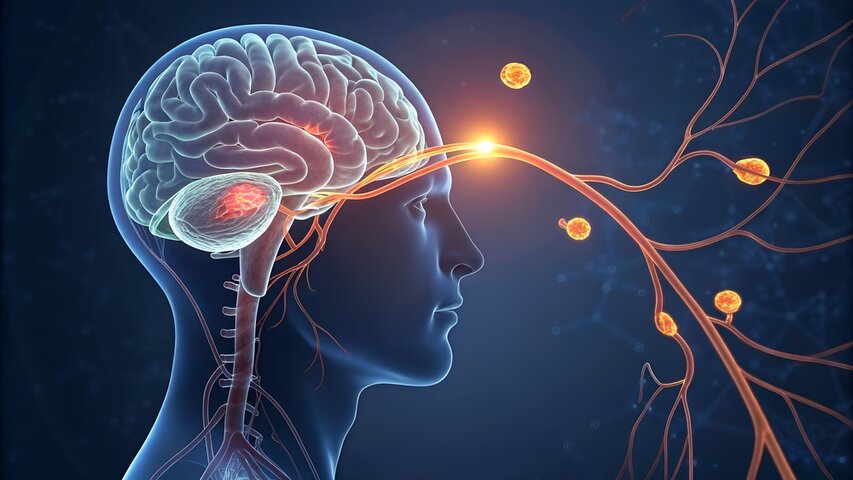 The antagonist is somatostatin. This hormone has an inhibitory effect and ensures that growth hormone is not released continuously. It therefore prevents overproduction and helps maintain the correct rhythm. Somatostatin is also produced in the hypothalamus, but also in other parts of the body (e.g. in the gastrointestinal tract), where it additionally regulates digestive processes. The interaction between the two substances is crucial: When GHRH dominates, the release of growth hormone increases sharply. When somatostatin predominates, it is slowed down or stopped entirely. During deep sleep, this balance shifts in favour of GHRH, whilst inhibitory influences such as stress hormones or neural activity decrease. This is precisely what causes the typical nocturnal growth hormone peaks.
Together, they coordinate hormonal activity across the sleep-wake cycle. As soon as growth hormone enters the bloodstream, it activates the locus coeruleus, a region in the brainstem that controls alertness, attention and cognitive functions. Disorders in this area are associated with a wide range of neurological and psychiatric conditions. “Understanding the neural circuitry governing growth hormone release could ultimately lead to new hormone therapies to improve sleep quality or restore normal growth hormone balance,” said Daniel Silverman, a postdoctoral researcher at UC Berkeley and co-author of the study. “There are some experimental gene therapies that target a specific cell type. This circuit could represent a novel approach to attempting to dampen the excitability of the locus coeruleus, something that has not been discussed before.”
How Sleep Phases Regulate Hormone Release
To investigate this system, the researchers recorded brain activity in mice by implanting electrodes and stimulating the neurons with light. As mice sleep in short bursts throughout the day and night, this provided a detailed insight into how growth hormone changes during the sleep phases. The team found that GHRH and somatostatin behave differently depending on whether the brain is in REM or non-REM sleep. During REM sleep, both hormones rise, leading to an increase in growth hormone. During non-REM sleep, somatostatin falls whilst GHRH rises more moderately, thereby also increasing hormone levels, but in a different pattern.The researchers also discovered a feedback loop linking growth hormone to wakefulness. During sleep, growth hormone gradually builds up and stimulates the locus coeruleus, prompting the brain to wake up. But there is a twist. If this brain region becomes too active, it can actually trigger drowsiness instead, creating a delicate balance between sleep and wakefulness.
“This suggests that sleep and growth hormone form a finely balanced system: too little sleep reduces the release of growth hormone, and too much growth hormone can in turn drive the brain towards wakefulness,” said Silverman. “Sleep drives the release of growth hormone, and growth hormone acts back to regulate wakefulness – and this balance is crucial for growth, recovery and metabolic health.”
This balance affects more than just physical growth. As growth hormone acts via brain systems that control alertness, it can also influence how clearly you think and how focused you feel. “Growth hormone not only helps build muscle and bone and break down fat tissue, but can also have positive effects on cognitive abilities and promote general alertness upon waking,” said Ding.
You may also be interested in...
-

-
Scientific evidence of the relationship between deep sleep and brain health has been rapidly increasing…
-
Science is coming to an increased recognition of the importance of sleep to long-term brain…