Longer, brighter evenings sound tempting. But year-round daylight saving time could have significant consequences for our natural sleep-wake cycle. A new U.S. study shows how many children would have to be out and about in the dark in the mornings as a result. Behind this lies a fundamental question of chronobiology: How much does our body need natural morning light to stay in sync?
Daylight Saving Time: When the Clock No Longer Matches Our Natural Rhythm
We’ve just gone through another daylight saving time change. Twice a year, we adjust our clocks. In the spring, we set them forward one hour; in the fall, we go back to standard time. For many people, the time change is, above all, a nuisance. It disrupts sleep, makes it harder to get up, and can leave you feeling for several days as though your daily rhythm is out of sync.
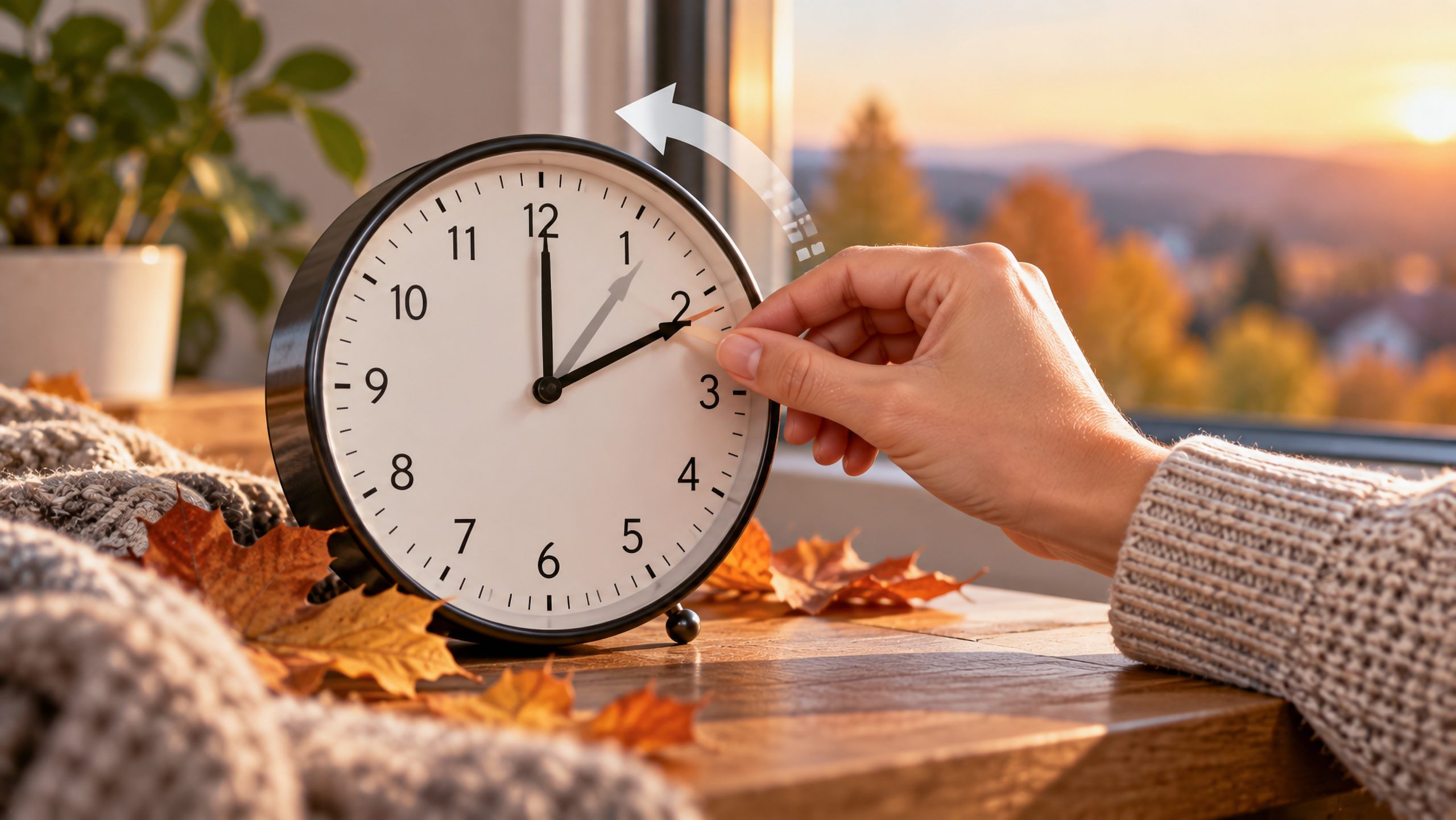 But the debate over the time change goes far beyond the hour gained or lost. There is repeated talk of abolishing the twice-yearly change and permanently sticking to a single time. Year-round daylight saving time, in particular, has its advocates because it promises more daylight in the late afternoon and evening during the winter.
From a chronobiological perspective, however, this solution is not without its problems. While we might enjoy longer, brighter evenings, the sun would rise correspondingly later in the winter. It is precisely this lack of morning light that could become a problem for our internal clock. A new study from the University of Washington illustrates the potential consequences particularly clearly by examining children’s daily school routines.
Billions of Additional School Commutes in the Dark
The American researchers investigated what effects year-round daylight saving time might have on children who have to go to school in the morning. To do so, they analyzed data on school locations, student enrollment, and start times in several U.S. states. The result is remarkable: If daylight saving time were in effect year-round, at least two billion additional school commutes could take place before sunrise in the U.S. The scientists compared the proposed permanent daylight saving time with the current system, in which clocks are set back to standard time in the fall.
Particularly significant changes were observed in individual states. For Washington, the team calculated nearly 35 million additional trips to school in the dark. In Georgia, the figure was as high as around 71 million. The researchers also examined traffic accidents involving school-age children. They found that fatal accidents involving young pedestrians were roughly twice as common on dark mornings as they were after sunrise. The results were published in the journal Current Biology. Although the study focuses on the U.S., the underlying issue is relevant internationally: When societal schedules are permanently shifted relative to the natural position of the sun, this can have implications for safety, sleep, and biological rhythms.
Our Internal Clock Isn’t Synchronized With Our Wristwatch
There’s a simple reason why a one-hour time shift can affect the body: Our organism has its own biological timing system. This internal timer is called the circadian clock. It controls numerous processes that repeat approximately every 24 hours. These include the sleep-wake cycle, body temperature, the release of various hormones, metabolism, and changes in alertness.
 The internal clock is located in the brain, more specifically in the suprachiasmatic nucleus (SCN), a small region of the hypothalamus. It processes information about the brightness of the environment, which is detected by special light-sensitive cells in the retina. In this way, the brain receives information about when it is day and when it is night.
Morning light is particularly important in this regard. It helps the body initiate the biological day and regularly synchronize the internal clock with the actual course of the day. In the evening, the system works in the opposite direction: As it gets darker, the body’s readiness to prepare for nighttime typically increases. The release of the sleep hormone melatonin increases, while alertness and activity gradually decrease. Our internal clock is thus guided not by the time on the clock, but primarily by natural light conditions.
Why Morning Light Is So Important for the Circadian Rhythm
Light is the most important external timekeeper for our internal clock. Morning daylight, in particular, plays a central role in synchronizing the circadian rhythm. When the eyes are exposed to bright daylight after waking up, the brain receives a clear signal that the new day has begun. This sets the internal clock to the course of the day.
Without this light, the biological rhythm can shift later. This means that the body may become tired later and also take longer to get going in the morning. Artificial light in the evening can also influence this process. Bright light in the late evening hours can suppress melatonin release and delay the natural time for falling asleep.
Therefore, it is not only crucial how many hours we sleep, but also when we experience light and darkness. A permanent daylight saving time would mean, especially in winter, that many people would remain in the dark longer in the morning while simultaneously being exposed to artificial or natural light longer in the evening. From a chronobiological perspective, this combination can be unfavorable.
Daylight Saving Time or Standard Time: Which Is Better for the Body?
In the discussion about abolishing the time change, two options are often weighed against each other: permanent daylight saving time or permanent standard time. With year-round daylight saving time, clocks would remain one hour ahead of the actual standard time. In winter, the sun would rise correspondingly later. In return, it would stay light longer in the afternoon and evening. Permanent standard time, on the other hand, is more closely aligned with the natural position of the sun. Dawn and sunrise occur earlier on the clock, while it gets dark earlier in the evening.
 From a chronobiological perspective, there are strong arguments in favor of permanent standard time. The American Academy of Sleep Medicine, for example, recommends abolishing seasonal time changes and maintaining standard time year-round instead. The British Sleep Society also emphasizes in its scientific statement the importance of natural morning light for sleep and circadian health. This is not to say that a single hour’s time shift inevitably makes people sick. Rather, a persistent mismatch between biological and societal time can disrupt the natural sleep-wake rhythm.
What Happens When biological and Societal Time Drift Apart?
In chronobiology, this phenomenon is referred to as circadian misalignment or circadian desynchronization. It occurs when the internal biological clock is no longer well-aligned with the external demands of daily life. Factors such as early work hours, shift work, irregular sleep schedules, or an unfavorable distribution of light and darkness can contribute to this. A well-known example is so-called “social jet lag.” In this case, the times for going to sleep and waking up differ significantly between workdays and days off. As a result, the body must repeatedly adapt to different schedules.
A permanent daylight saving time could exacerbate this discrepancy for people who have to get up early in the morning. While the societal clock already dictates a specific start to the day, the biological rhythm may still be in a later phase. This can manifest, among other things, as morning fatigue, difficulty getting out of bed, and reduced performance. People with a late chronotype may be particularly affected. They naturally get tired later and have a harder time getting going in the morning. For them, an early societal start to the day can be a challenge anyway.
Children and Adolescents Need Particularly Reliable Light Cues
The University of Washington study focuses primarily on children and adolescents. This is particularly interesting from a chronobiological perspective. During puberty, the internal clock shifts later for many adolescents. They get tired later in the evening and would often like to sleep in longer in the morning. At the same time, school often starts at a fixed early time. A permanent summer time could further complicate this situation if the walk to school in winter takes place even more in the dark.
 This isn’t just a matter of traffic safety. Morning daylight is also important for synchronizing the internal clock. If children receive hardly any natural light in the morning right after getting up, an important external time cue is missing. Scientists at the University of Washington therefore point out that the discussion about the time change should also take into account school start times and children’s daily living conditions. One possible adjustment would be to start school later. However, this would have implications for families, work schedules, and the overall organization of the day.
The Discussion is Not Just an American Issue
In the U.S., there has been a debate for years about abolishing the biannual time change. The so-called Sunshine Protection Act is intended to establish permanent daylight saving time. However, its political implementation remains unresolved. The new study from the University of Washington provides additional arguments for the debate because it calculates the potential consequences based on specific school commutes and traffic data. In Europe, too, the issue is by no means new. The European Parliament already spoke out in favor of abolishing mandatory daylight saving time in 2019. However, member states have so far been unable to agree on a common implementation plan.
A key issue here is coordination among countries. Different national time regulations could, for example, complicate cross-border transportation, trade, and cooperation. The chronobiological question, however, remains unaffected: Which time regulation best aligns with natural light conditions and the human biological rhythm?
What We Can Do Ourselves for Our Internal Clock
Regardless of whether daylight saving time is eventually abolished, we can support our circadian rhythm in everyday life. It is particularly helpful to get daylight as early as possible in the morning. Even a walk after getting up or the commute to work in daylight can serve as an important cue for the body’s internal clock. Regular bedtimes and wake-up times also help the body develop a stable rhythm. Those who sleep several hours longer on weekends than on weekdays may repeatedly shift their biological daily rhythm.
In the evening, on the other hand, it’s a good idea to reduce the light intensity. Bright light, especially from screens and strong room lighting, can interfere with the body’s natural preparation for sleep. In addition, regular meals and physical activity can help stabilize various biological rhythms in the body. It is important to integrate the natural day-night cycle into one’s daily routine as effectively as possible. This is because our internal clock needs reliable signals to coordinate sleep, activity, and metabolism.
The Sun Sets the Pace — Not the Clock
The new study from the U.S. shows that the decision to adopt permanent daylight saving time could have far-reaching consequences than initially suspected. Children who have to go to school early in the morning, in particular, could be more severely affected by the later dawn. But the findings also draw attention to a fundamental insight of chronobiology: Humans are biological beings whose internal clocks have adapted over millennia to the natural cycle of light and darkness.
Our societal schedules cannot arbitrarily alter this rhythm without creating new challenges. The question, therefore, is not merely whether we would prefer longer, brighter evenings in winter. What is also crucial is how well a schedule aligns with our bodies’ biological needs. After all, our internal clock is not guided by what the clock displays; it is primarily guided by when the sun rises and when it gets dark.
You may also be interested in...
-

When it comes to the concept of "daylight saving," modern people simply accept the twice-annual…
-
When daylight saving time ends, you might stay up late the weekend of the time…
-
Sleep disturbances are surprisingly common in the Western world. Many people struggle to get to…