No sooner has the alarm clock stopped ringing than, for many people, the morning routine begins: getting up, making the bed, showering, and brewing coffee. The bedroom should look tidy before the day really gets underway. But when it comes to making the bed, of all things, it might make sense to change the usual order of things. Instead of smoothing out the comforter right away, let it remain pulled back for a moment. There’s a very practical reason behind this: During the night, we release heat and moisture into the bedding. If the bed is covered immediately after getting up, the moisture has a harder time escaping. An uncovered bed, on the other hand, allows the bedding and mattress surface to air out better.
There’s also a second, less obvious aspect to this topic. The time after waking up is also important for our internal clock. Light, movement, and regular daily routines help the body distinguish between night and day. However, it’s important to keep the two separate: Airing out the bedding primarily affects the sleeping environment, while light, in particular, plays a central role in regulating our biological day-night rhythm.
The Internal Clock Doesn’t Just Start Ticking in the Evening
Our body follows an approximately 24-hour rhythm that coordinates numerous biological processes. These include the sleep-wake cycle, body temperature, the release of certain hormones, and changes in alertness throughout the day. These rhythms are controlled by what is known as the circadian system. Its most important pacemaker is located in the brain: the suprachiasmatic nucleus, a small structure in the hypothalamus. It receives information about light conditions from the retina and helps synchronize our internal time with the external day-night cycle.

The internal clock is not simply a stopwatch that reacts solely to waking up. It works continuously—even while we sleep. However, its synchronization with the environment is influenced by certain signals, which are referred to in chronobiology as timing cues. Light is the most important external timing cue for humans. This explains why our daily routine is more than just a sequence of practical tasks. The light conditions in the morning, the brightness during the day, and the increasing darkness in the evening provide the body with information about which phase of the day is currently underway.
Research shows that the effect of light depends not only on its brightness but also on its duration, timing, and spectral composition. Depending on when we are exposed to light, it can shift the phase of our internal clock and directly influence our alertness.
Morning Light: An Important Signal to Start the Day
When you open the curtains in the morning or go outside, you expose your body to a natural signal marking the start of the day. Light reaches specialized light-sensitive cells in the retina, which relay information about the brightness of the environment to the circadian system. This is not merely about being able to see better in bright light. Light also influences non-visual processes in the body. For example, it can alter melatonin regulation, promote alertness, and—depending on the biological time of day—shift the internal clock.
Melatonin is often referred to as the sleep hormone. Its secretion typically rises in the evening under dark conditions and decreases again as the biological morning progresses. Daylight in the morning helps synchronize this rhythm with the natural light-dark cycle. However, the strength of this effect depends on several factors. These include the individual’s internal clock, light intensity, the duration of light exposure, and whether the light reaches the eyes during the biological morning or at another time.
A systematic review on light and human circadian rhythms describes these time-dependent effects in detail. Another scientific review in the journal Clocks & Sleep also shows that light can influence both the internal clock and levels of wakefulness and sleep. For everyday life, this means it makes sense not to start the day exclusively in a dimly lit indoor space. Exposure to daylight after waking up supports a regular light-dark cycle. It doesn’t always have to be bright sunshine. Even on cloudy days, it’s usually much brighter outdoors than indoors. The extent of this difference depends on the weather, time of day, and surroundings.
Why Regular Wake-Up Times Are So Important
Not everyone wakes up at the same pace in the morning. Some people are productive immediately after getting up, while others need significantly longer to be able to concentrate. Part of this variation is related to chronotype. People with a more “early” chronotype usually get tired earlier and naturally wake up earlier. With a “late” chronotype, the preferred window for sleep and activity shifts later. These differences are partly biologically determined and cannot be eliminated at will through sheer willpower. In addition, what is known as “sleep pressure” plays a role. It increases while a person is awake and decreases again during sleep. How it develops depends, among other things, on how long a person has already been awake and how much sleep they’ve had previously.
The body’s internal clock and sleep pressure work together. That is why someone may feel tired in the morning despite spending enough time in bed if the wake-up time is out of sync with their individual biological phase or if their sleep was not sufficiently restorative. Getting up at as consistent a time as possible can help stabilize the sleep-wake rhythm. This does not mean that everyone has to get up at exactly the same time. Rather, what matters is that one’s personal rhythm remains as consistent as possible and allows for sufficient sleep.
People who get up very early during the week but regularly sleep several hours longer on the weekends significantly alter their sleep rhythm. This can make it difficult to synchronize the internal clock with daily life. The recommendations from the U.S. National Institutes of Health therefore cite a regular sleep schedule, sufficient sleep, and exposure to daylight during the day as key components of healthy sleep habits.
First Things First: What Makes for a Sensible Morning Routine
There is no scientifically proven requirement to start the day with a specific sequence of rituals. Not everyone needs to meditate, take a cold shower, or exercise before breakfast. Much more important are habits that fit into your own daily life and can be sustained over the long term.
1. Open the curtains and let daylight in
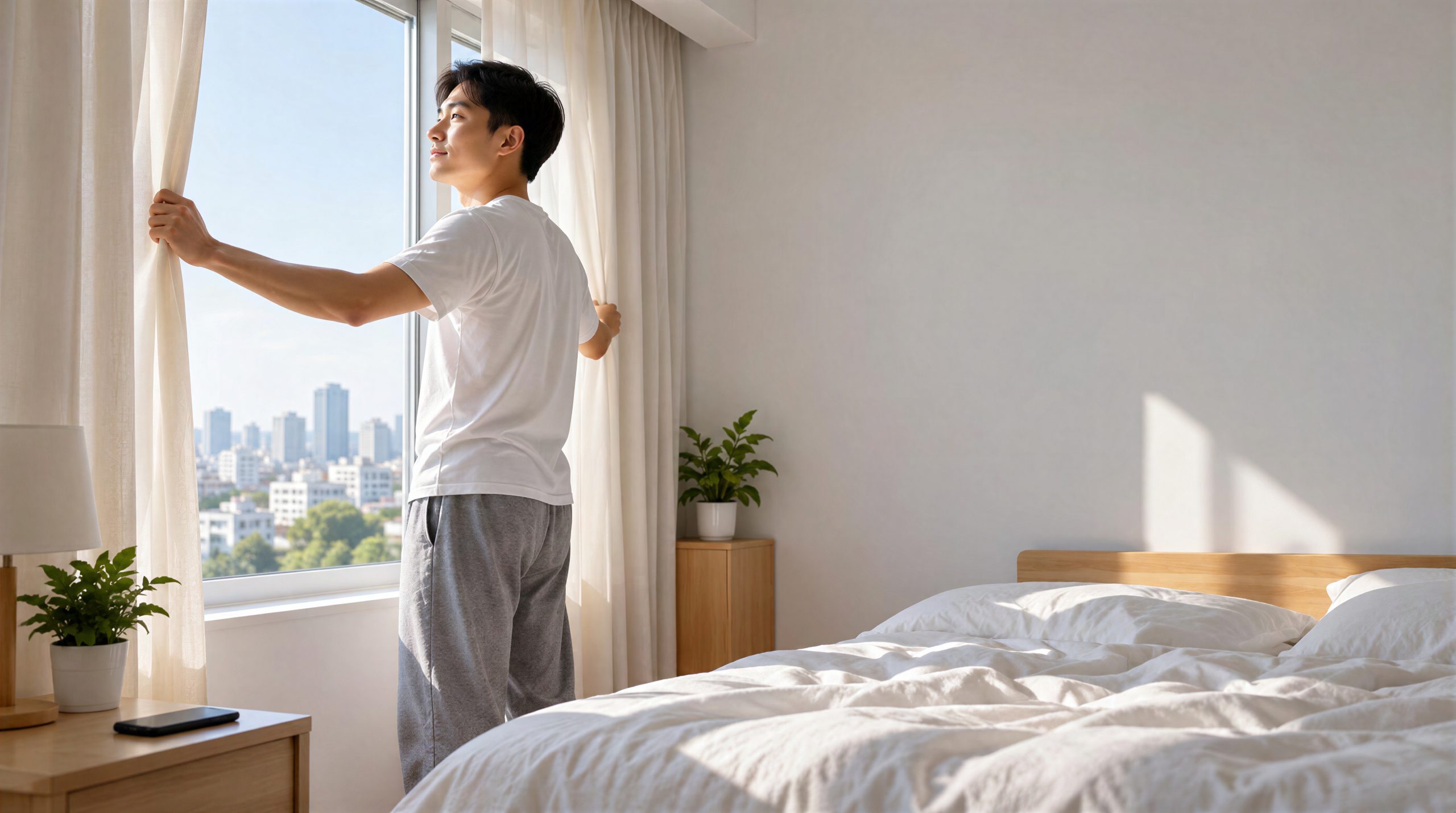 The first simple step is to let more light into the bedroom. It’s even better to spend time outdoors as early in the day as possible—for example, on the way to work, during a short walk, or while having breakfast on the balcony.
The benefit isn’t that a specific morning ritual immediately resets your internal clock. Rather, a consistent light environment helps align your circadian rhythm with the day-night cycle.
If you leave the house in the dark in the morning due to the season, you can consciously plan time outdoors during the day. However, in cases of severe sleep problems or suspected circadian rhythm disorders, targeted light therapy should be carried out under professional supervision.
2. Pull back the covers and let the bed air out
While we sleep, we release moisture into our surroundings through our skin and breathing. Combined with body heat, this creates a microclimate in the bedding that is also conducive to dust mites. Dust mites are microscopic arachnids that feed on human skin flakes, among other things. They are found in many households and thrive in mattresses, pillows, and comforters. For people with a dust mite allergy, their allergens are of particular concern.
As early as 2005, Kingston University in the UK reported on the idea that pulling back the comforter and allowing the bedding to dry out could make living conditions less favorable for the mites. The findings at that time were based on studies of indoor climate and on modeling. However, this is not proof that a dust mite population can be reliably eliminated simply by leaving the bed unmade. The extent to which the mite population actually decreases depends, among other things, on temperature, humidity, bedding materials, and other conditions in the bedroom.
Nevertheless, it’s a simple habit to pull back the comforter in the morning and let the bedding air out, rather than covering the bed completely right away. It’s also important to ventilate the bedroom regularly and wash the bedding according to the care instructions. For those with a severe dust mite allergy, additional measures such as mite-proof protective covers may be advisable. Simply leaving the bed uncovered is not a substitute for such measures.
3. Gently Get Your Circulation Going
After a night’s sleep, light exercise can help you get ready for the day. A few steps around the apartment, gentle stretching exercises, or a short walk are sufficient. While exercise is no substitute for daylight, it can be beneficial as a regular part of your daily routine. Physical activity also interacts with the circadian system. Its effect depends, among other things, on the time of day and the intensity. If you still feel stiff or tired in the morning, you don’t have to jump right into an intense workout. A short, pleasant start is often easier to stick with over the long term.
4. Drink coffee in moderation
For many people, coffee is as much a part of the morning as opening the curtains. Caffeine can increase alertness by blocking the effects of adenosine—a neurotransmitter involved, among other things, in building up sleep pressure. However, the widespread claim that everyone must wait a certain number of minutes after waking up before drinking coffee is not sufficiently supported by science. There is no universal rule stating that coffee should only be consumed 60 or 90 minutes after waking up.
What matters more is how much caffeine a person consumes and how sensitive they are to it. Caffeine can remain effective for many hours after consumption and, in people who are particularly sensitive, can interfere with falling asleep or the quality of sleep. People who have trouble sleeping should therefore focus on reviewing their caffeine intake and the timing of their last cup of coffee. This can be more helpful than sticking to a supposedly “perfect” morning coffee time.
The Bedroom as a Transition Between Night and Day
The bedroom is a special space: at night, it should facilitate sleep; in the morning, it marks the transition into the waking phase. Temperature, light, noise, and air quality can all influence how comfortable this environment is. For the body’s internal clock, the change in lighting conditions is particularly important. An environment that is bright during the day and gradually becomes darker in the evening better aligns with the natural light-dark cycle than a daily routine with constant dim lighting and plenty of bright light late into the night.
The sleeping environment itself also deserves attention. A room that is sufficiently dark and quiet and maintains a comfortable temperature can make it easier to fall asleep. Regular ventilation and proper care of bedding also contribute to a comfortable indoor climate.
However, it’s important not to confuse these individual factors: A well-ventilated mattress does not automatically regulate the body’s internal clock. Conversely, morning light is not a means of eliminating dust mites. These are different measures, each affecting different aspects of sleep health.
What About Evening Light?
Those who get more daylight in the morning should also consider the other end of the day. Bright light in the evening can shift the circadian rhythm later and affect the body’s natural preparation for sleep. The extent of this effect depends, among other things, on intensity, duration, spectral composition, and the specific time of day.
 Therefore, it may be helpful to reduce lighting in the hours leading up to bedtime. Very bright screens and other light sources can also be a factor, though it’s not just the screen that matters—it’s the total light exposure and your personal sleep rhythm.
The point isn’t to turn off every light in the evening or to ban screens altogether. What matters is a lighting environment that’s suited to the upcoming sleep. If you regularly have trouble falling asleep, you can try to see if dim lighting in the evening and more daylight in the morning help support your natural rhythm.
When a Morning Routine Isn’t Enough
Persistent tiredness in the morning isn’t automatically a sign of a misaligned internal clock. Insufficient sleep, frequent nighttime interruptions, shift work, certain medications, and health issues can also play a role.
Anyone who consistently wakes up feeling unrested despite getting enough sleep, is very sleepy during the day, or snores loudly and notices pauses in breathing should seek medical evaluation. Significant difficulty falling asleep or getting up in the morning can also indicate a sleep disorder or an improperly synchronized sleep-wake rhythm. A healthy morning routine can be helpful, but it is no substitute for a medical evaluation if symptoms persist.
Conclusion: It’s Not the Perfectly Made Bed that Matters, But the Right Daily Rhythm
The idea of letting the bed air out in the morning is a simple and reasonable tip for maintaining a healthy sleep environment. However, the extent to which this reduces dust mite exposure has not been conclusively determined. From a chronobiological perspective, another habit is far more important: regularly exposing the body to the natural signals of the day. Morning sunlight, a sleep-wake cycle that is as stable as possible, sufficient sleep, and less bright light in the late evening can help synchronize the body’s internal clock with daily life.
No one needs to develop a complicated morning routine to achieve this. Simply opening the curtains, making the bed, and planning a short walk outside when possible are easy steps. The most important insight, therefore, is this: it’s perfectly fine to leave the bed a little unmade in the morning. For the body’s internal clock, however, it’s not the bedspread that matters most, but rather the proper alternation between light, darkness, activity, and rest.
You may also be interested in...
-

It is believed that light in the evening is bad for sleep. But does the…
-
More than 50 percent of Americans use coffee and other caffeinated beverages on a regular…
-
Chronobiology is one of the most studied topics in modern medicine. It is no surprise…