Talking through a difficult problem can help some people organize their thoughts. However, according to cognitive neuroscientists at MIT’s McGovern Institute for Brain Research, language itself is not necessary for logical thinking.
In a study recently published in the journal PNAS, a team led by Evelina Fedorenko, associate professor of brain and cognitive sciences at MIT, found that people can successfully solve problems requiring logical thinking even when their language skills are severely impaired. Brain imaging techniques also showed that the regions responsible for language processing are not activated during logical thinking.
Are Language and Thinking Really Connected?
For millennia, philosophers, linguists, and cognitive scientists have debated whether language is indispensable for thinking. Many hold the view that humans use language as a tool for thinking. Hope Kean, a postdoctoral researcher and former fellow at the K. Lisa Yang Integrative Computational Neuroscience (ICoN) Center in Fedorenko’s lab, says there are plausible reasons to believe that language and logic might be closely linked. “Abstract thinking exhibits characteristics that are very similar to language,” says Kean, pointing to structural similarities. “You can break a thought down into subcomponents—like tiny atoms of logical statements—and combine them hierarchically to form more complex structured rules—much like in language.”

Nevertheless, Kean and Fedorenko, who is also a researcher at the McGovern Institute, suspected that the brain might separate the communication of logical thinking from logical thinking itself. People rely heavily on language when they describe a problem, discuss possible solutions, or explain how they arrived at a conclusion. The underlying process of logical thinking, however, might depend on a different brain system. “There are aspects of thinking that seem to go beyond some of the limits of language,” Kean explained. Logical thinking often requires a level of precision that everyday language does not provide. Language also unfolds in a linear sequence, one word at a time, whereas reaching a logical conclusion may require considering multiple pieces of information in a way that is less linear.
Testing Logical Thinking Without Language
These questions prompted Kean to investigate how the brain actually carries out logical thinking. Researching this topic is challenging because researchers working with human subjects typically rely on language to explain tasks and obtain responses. Fedorenko’s group found a way to circumvent this obstacle by collaborating with Rosemary Varley, a neuroscientist at University College London who studies acquired language disorders, and her team.
The researchers studied two individuals who had suffered a stroke that had damaged the areas of the brain responsible for language processing. Both had significant difficulty understanding and producing language. To test logical thinking independently of language, the researchers developed logic games that focused on numbers and visual patterns. In one task, participants were shown two lists of numbers and had to identify the hidden rule by which one list transformed into the other. Such a rule might, for example, involve reversing the digits or removing numbers above a certain value. After identifying the rule, participants had to apply it to new examples. In another task, participants were presented with a collection of geometric patterns. They then had to select the pattern that correctly completed the grid.
The more difficult the puzzles became, the more clearly the results showed that language was not necessary for this form of logical thinking. Participants with severe language impairments performed just as well as a control group. They were even able to communicate the rules they had discovered through gestures or sketches. “This really turns a theory on its head that claims symbolic rule induction is impossible without language skills,” says Kean.
Brain Scans Reveal a Separation Between Logic and Language
The researchers also investigated what happens in the brains of healthy adults while they solve logical problems. The participants came to MIT for a series of MRI scans, during which patterns of brain activity were recorded as they performed various tasks. Some tasks consisted of logic puzzles. Others were specifically designed to identify each participant’s language processing regions. A separate set of tasks mapped the so-called “multiple-demand network”—a distributed brain system that supports the solution of complex problems.
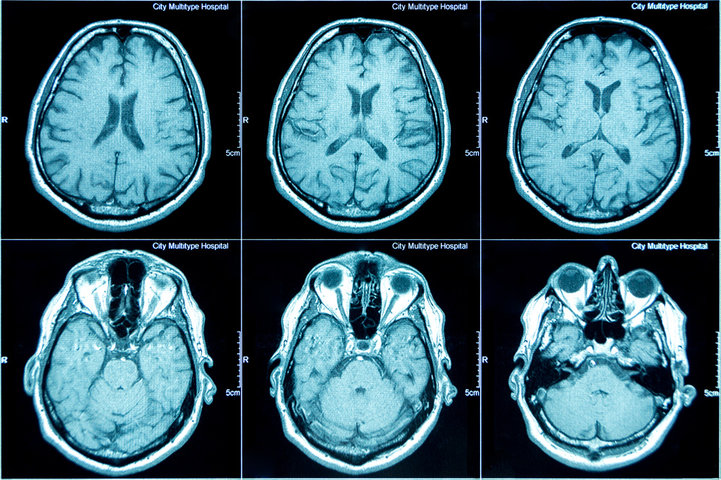 The neurotypical participants solved logic puzzles similar to those presented to participants with language impairments. They also worked through problems that required syllogistic reasoning. These tasks used “if-then” statements such as “If the ball is red, then it is big. The ball is red. Is the ball big?” The researchers adjusted the difficulty level of the puzzles to determine which areas of the brain became more active as the cognitive effort increased. They also compared brain activity when participants had to discover a hidden rule with the activity when they were simply applying a rule that had already been given.
The scans revealed a clear distinction between language and logic. The brain’s language system was not activated during inductive reasoning (when participants identified hidden rules) or during deductive reasoning (when they evaluated the validity of syllogistic inferences). The findings regarding the “multiple-demand network” were more unexpected. Scientists had suspected that this network would play an important role in logical thinking. Although it became active during inductive reasoning, it did not appear to be involved in deductive reasoning. Kean is further investigating this finding in her ongoing research. For Fedorenko and Kean, the results provide strong evidence that language and logic are based on different systems in the brain. The results also build on earlier work from Fedorenko’s lab, which showed that other forms of thinking—including object categorization and social thinking—do not depend on language.
What Role Does the Internal Clock Play in Thinking?
At the same time, the results raise an interesting question for chronobiology: If logical thinking occurs independently of language in its own brain networks, their performance could also be influenced by the biological clock. Attention, concentration, and cognitive performance are subject to natural fluctuations throughout the day and are influenced, among other factors, by the sleep-wake cycle, hormones such as melatonin and cortisol, and an individual’s chronotype. People may therefore perform differently depending on the time of day, even though their fundamental abilities remain unchanged. The present study did not examine this temporal influence. However, future research could clarify whether the brain networks responsible for logical thinking are also subject to certain diurnal fluctuations and whether complex thinking tasks can be completed more easily or efficiently at specific times.
What the Results Mean for Aphasia
This research could have important implications for how people understand acquired language disorders, such as aphasia. Professionals who work with people with aphasia have long known that the loss of language skills is not synonymous with a loss of intelligence. Someone with aphasia may still enjoy playing chess, solving Sudoku puzzles, or managing the family finances. Nevertheless, some people mistakenly interpret communication difficulties as signs of cognitive problems.

“This research adds to a growing body of work showing that even people with severe aphasia can retain their capacity for abstract logical thinking—a hallmark of our species,” said Fedorenko. “We should continue to educate the public that language difficulties—whether due to aphasia, speech-language disorders such as stuttering, or for those whose native language is not English—are not an indication of how intelligent or capable someone is.”
A Potential Insight for Artificial Intelligence
The findings could also have implications for artificial intelligence. Large language models like ChatGPT and Claude are trained exclusively on text and output text as results, yet they can convincingly simulate certain forms of human thinking.
The human brain appears to function differently. In humans, language and abstract logical thinking are separate processes. According to Kean, investigating the differences between human thinking and how large language models operate could provide useful insights for the development of future AI systems.
A precise understanding of how the human brain draws conclusions remains an open area of research. Kean describes it as a new frontier in the geography of thought—and one she is eager to explore.
You may also be interested in...
-

A recent scientific revelation demonstrated that the internal body clock controls brain waste removal. Previously,…
-
Body temperature reflects more than the weather outside. According to a new study, our temperature…
-
Virtually every cell in the human body has an internal clock. These clocks are controlled…